
Why Terminals Matter
Understanding Liquid Terminals
What Is a Liquid Terminal?
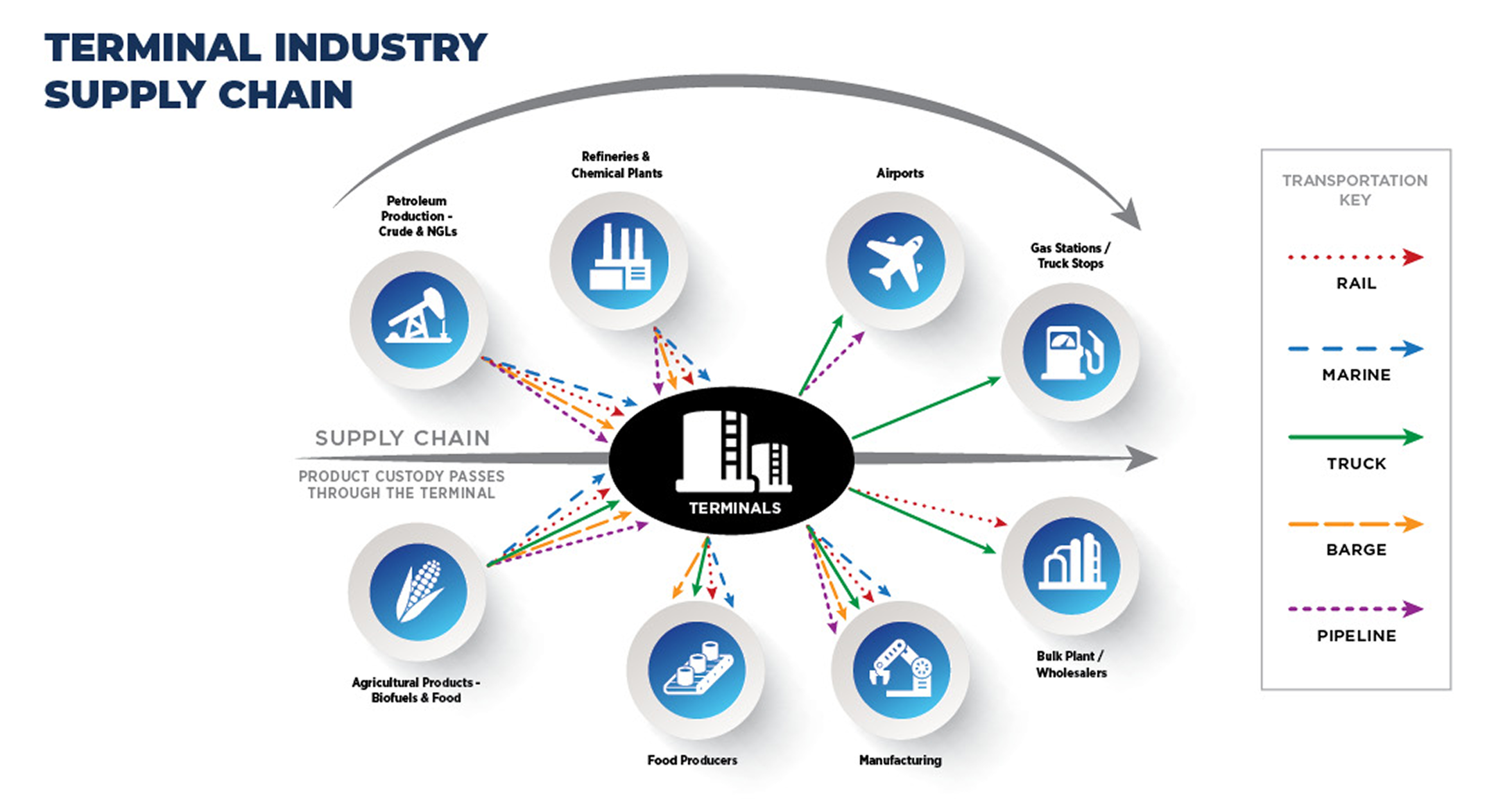
Liquid terminals and above-ground storage tank facilities (tank farms) play a critical role in the transportation and storage of bulk liquid commodities. These facilities connect major modes of transportation—including ships, barges, tank trucks, rail cars, and pipelines—to safely receive, store, transfer, and distribute products.
The commodities handled at liquid terminals include chemicals, crude oil, petroleum products, renewable fuels, asphalt, animal fats and oils, vegetable oils, molasses, fertilizers, and other bulk liquids. Terminal customers include oil producers, chemical manufacturers, product manufacturers, food producers, utilities, transportation companies, commodity brokers, government agencies, and the military.
Powering Everyday Life
A Terminal's Role in
Transportation and Distribution
Liquid terminals are essential links in the nation’s supply chain, providing the infrastructure and logistics needed to move bulk liquid commodities safely and efficiently from origin to destination. While storage is a key function, terminals also facilitate the transfer of products between transportation modes, allowing commodities to move seamlessly from ships to pipelines, barges to trucks, or rail to storage.
For example, crude oil arriving by oceangoing tanker may be unloaded at a marine terminal before being transferred by pipeline to a refinery. Once refined, products such as gasoline are transported in bulk to distribution terminals, stored in above-ground tanks, and loaded into tank trucks for delivery to retail fueling stations. Similar processes support the movement of chemicals, renewable fuels, food-grade products, and countless other commodities that businesses and consumers rely on every day
Community Impact
Terminals Support Local Communities
Liquid terminals contribute to the economic vitality of communities around the world. Terminal companies provide skilled, high-quality jobs across a wide range of disciplines, including operations, engineering, environmental management, safety, information technology, security, sales, marketing, and business development. They also generate significant local investment and tax revenue that helps strengthen the communities where they operate.
Safety Through Compliance
Terminals Operate Under
Comprehensive Regulatory Oversight
The U.S. liquid terminal industry operates under a comprehensive framework of federal, state, and local regulations governing facility design, construction, operations, environmental performance, worker safety, facility security, emergency preparedness, and the transportation of liquid commodities.
In addition to complying with regulatory requirements, terminal companies follow recognized industry standards, guidelines, and recommended practices that promote safe, reliable, and environmentally responsible operations.
Learn more about the regulatory framework and industry standards that govern the liquid terminal industry by downloading ILTA’s Regulatory Fact Sheet.
Where the Liquid Terminal Industry Comes Together
Connect with terminal operators and suppliers to strengthen operations, inform policy, and build valuable business relationships.
